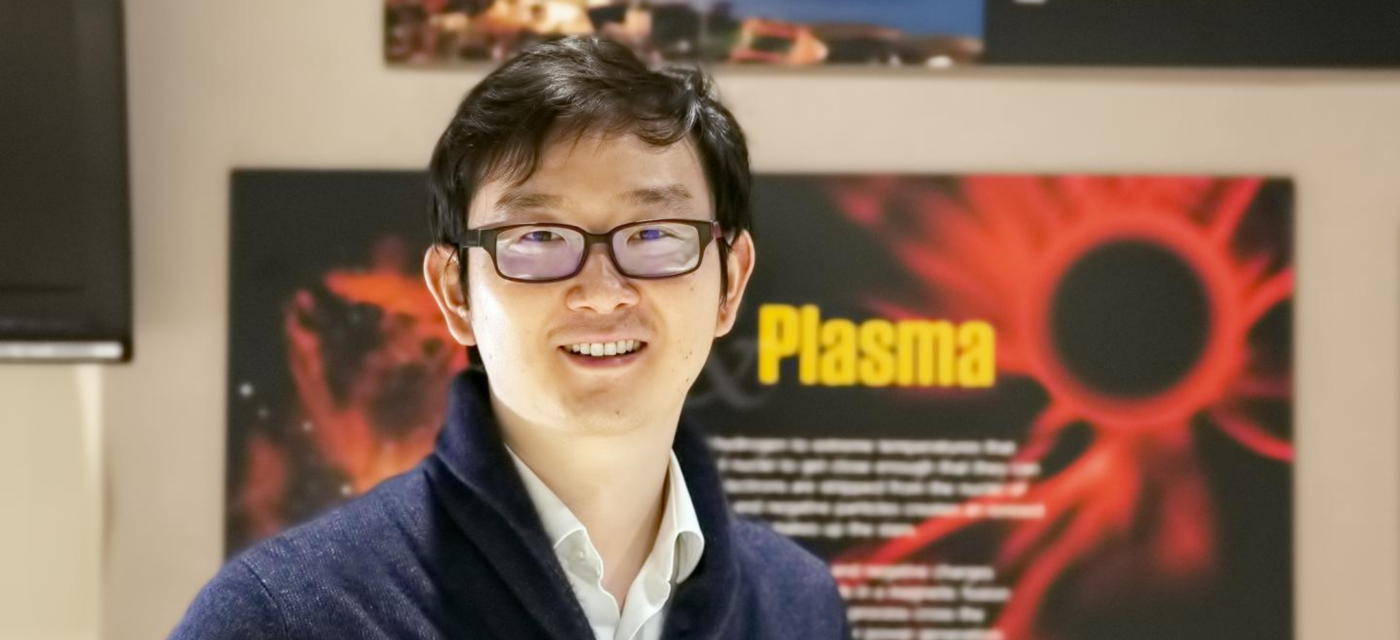
Professor Chuanfei Dong is an assistant professor of astronomy at Boston University and a member of the Mauve Science Programme. In this spotlight, he explores how stellar flares and coronal mass ejections shape planetary environments, and how Mauve’s ultraviolet observations can help us understand the conditions that influence planetary habitability.
Can you please introduce yourself?
“I am an assistant professor in the Department of Astronomy at Boston University and a faculty member in the Center for Space Physics. My research focuses on how stars interact with planets, both in our Solar System and beyond. I use physics-based computational models together with spacecraft and astronomical observations to study how stellar winds and storms interact with planetary upper atmospheres and magnetospheres, the associated atmospheric escape, and fundamental plasma processes such as magnetic reconnection and plasma turbulence. A central goal of my work is to understand how a star’s magnetic activity shapes the environment and long-term habitability of its planets. I am also interested in physics-informed machine learning and laboratory astrophysics. Mauve brings these interests together by providing a new ultraviolet view of active stars and their influence on planetary systems.”
What inspired you to pursue research in your field?
“I was drawn to this field by a fundamental question: is Earth unique, or are there other worlds capable of supporting life? Answering that question requires us to look beyond a planet itself and understand the star that governs its environment. Stars release radiation, energetic particles, and magnetized plasma, all of which can alter atmospheric chemistry and drive atmospheric loss over time. Plasma physics provides a powerful framework for connecting these processes across enormous scales, from magnetic reconnection in a laboratory or the solar corona to the evolution of an exoplanetary atmosphere. I find that combination of fundamental physics and a profound astrobiological question especially compelling. Each new mission and dataset gives us another piece of the puzzle of how habitable environments arise and endure.”
Mauve’s time-resolved spectra from 200 to 700 nanometres will provide empirical constraints that are difficult to obtain from the ground and are not routinely available through existing space observatories.
Professor Chuanfei Dong
How does your involvement in Mauve align with your research interests?
“Mauve aligns directly with my research on star-planet interactions and planetary habitability. My models examine how stellar winds, flares, coronal mass ejections, and high-energy radiation affect planetary magnetospheres and atmospheres. The reliability of those models depends on realistic measurements of the host star, especially in the ultraviolet, where stellar activity can strongly influence atmospheric escape and photochemistry. Mauve’s time-resolved spectra from 200 to 700 nanometres will provide empirical constraints that are difficult to obtain from the ground and are not routinely available through existing space observatories. I am helping connect these stellar observations with the broader question of how energetic space-weather conditions shape planets and their prospects for habitability.”
Could you describe the science theme you are working on with Mauve?
“Our science theme aims to probe stellar coronal mass ejections, or CMEs, through ultraviolet and optical dimming signatures. CMEs are enormous eruptions of plasma and magnetic field. They are routinely observed on the Sun, but confirmed detections on other stars remain rare because those stellar surfaces cannot be spatially resolved. Mauve offers an indirect approach: after an energetic flare, an eruption may remove emitting plasma from the stellar atmosphere or place cooler material in front of the star, producing a persistent decrease in selected spectral features. We will use long-duration monitoring of active stars to search for these post-flare changes in diagnostics such as Mg II, Ca II H and K, and the Balmer series. Building a statistical picture of stellar CMEs will help us assess how frequently planets experience extreme space weather and how that exposure affects atmospheric retention and habitability.”
What aspect of Mauve are you particularly excited for?
“I am particularly excited by Mauve’s ability to monitor a diverse sample of active stars for extended periods in ultraviolet and visible light. That combination of wavelength coverage and time-domain observing is unusual. Flares and CMEs are transient and unpredictable, so a short observation can easily miss the event or its aftermath. Mauve can instead follow a star through the flare and into the period when a CME-related dimming may appear. Detecting these signatures beyond the Sun would open a new observational window on stellar space weather. I am also excited that Mauve is a focused, agile mission whose scientific programme is shaped by its members. It can test ambitious ideas, refine observing strategies as we learn from the data, and create opportunities for students and early-career researchers to contribute meaningfully.”
What synergies do you see between Mauve and other ground-based/space-based telescopes?
“Mauve is most powerful as part of a coordinated, multiwavelength observing programme. TESS and ground-based photometric surveys can identify optical flares and provide rotation periods, while Mauve measures how the same events evolve across the near-ultraviolet and visible spectrum. Ground-based spectroscopy can add higher-resolution measurements of H-alpha, Ca II H and K, and other activity indicators. Hubble can provide detailed ultraviolet spectra for selected targets, and X-ray observatories trace the hottest coronal plasma. Solar missions supply the spatially resolved benchmarks needed to interpret unresolved stellar signals. Together, these observations can distinguish flare heating from genuine post-flare dimming and strengthen the case for a CME. The resulting stellar inputs can then be coupled to numerical models of planetary magnetospheres, atmospheric escape, and photochemistry, and can inform future exoplanet missions such as the Habitable Worlds Observatory.”
How has your experience been working with the Mauve Science Collaboration?
“My experience with the Mauve Science Collaboration has been very positive. The team brings together researchers with expertise in stellar activity, exoplanets, young stars, hot stars, instrumentation, and time-domain astronomy. That breadth has led to constructive discussions about which questions Mauve can answer most effectively and how to translate them into practical target lists and observing strategies. I have especially valued the member-driven nature of the programme: scientists can contribute ideas early, learn from colleagues in adjacent fields, and adapt plans as the instrument’s on-orbit performance becomes clear. Developing the first-year science programme and its publication was a genuinely collaborative effort. It has been rewarding to see complementary ideas develop into a coherent programme and to help build a community around a new ultraviolet observatory.”
Is there anything else you would like to add?
“Mauve shows what can happen when a focused mission is built around a clear scientific need and a collaborative community. Although the satellite is small, the questions it addresses are large: how often do stars produce extreme eruptions, how do those events shape planetary atmospheres, and what conditions allow a world to remain habitable? I hope Mauve will create a durable ultraviolet time-domain dataset that supports discoveries well beyond the mission’s original themes. I am equally enthusiastic about its value for training. Students and early-career scientists can engage with the full scientific process, from observation planning and data analysis to physical interpretation. By connecting stellar astrophysics, plasma physics, planetary science, and astrobiology, Mauve can help cultivate the interdisciplinary perspective needed to understand planetary systems as complete, evolving environments.”