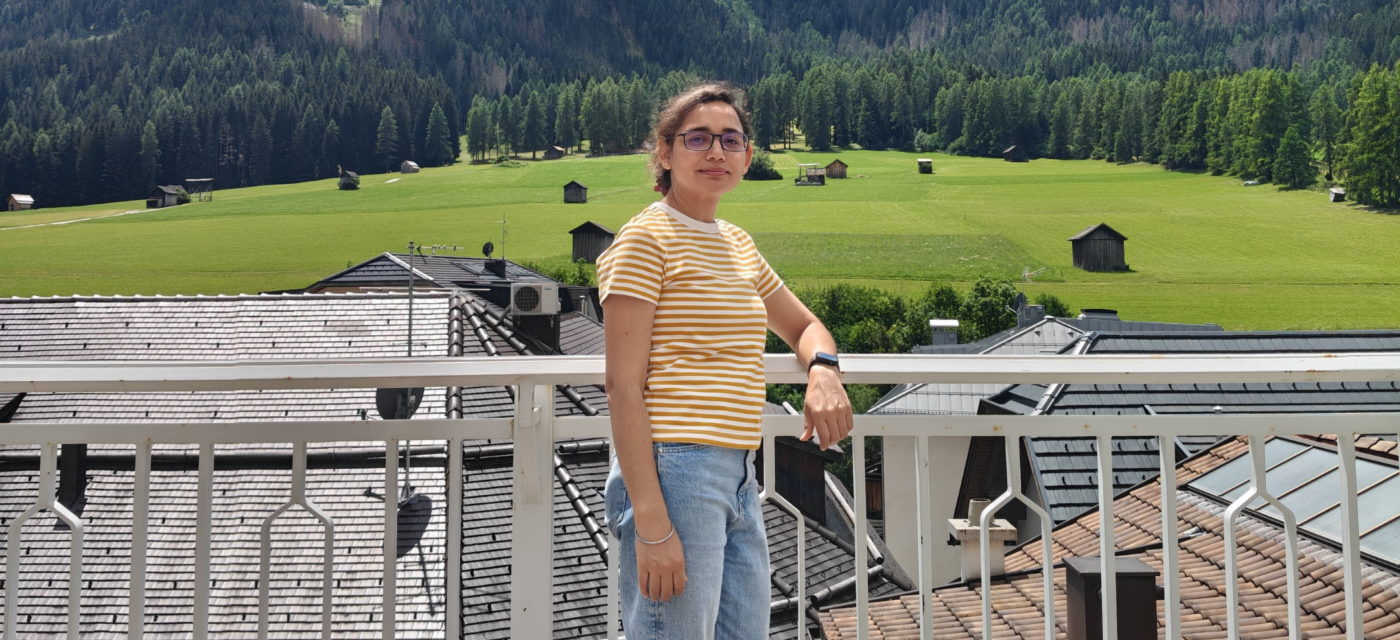
Dr Sharmila Rani is a post-doctoral fellow at INAF’s Osservatorio Astrofisico di Arcetri working with Dr Elena Pancino. In this member spotlight, she reflects on her career path, exotic stellar binaries and the gap bridged by Mauve data.
Can you please introduce yourself?
“I am an observational astronomer studying hot and exotic stars in diverse environments. To probe their origins, I primarily use photometric and low-resolution spectroscopic data from space-based UV telescopes, including AstroSat/UVIT, GALEX, Swift/UVOT, and IUE. I combine these UV data with optical and IR photometry to perform detailed multiwavelength studies. The leading scenarios proposed to explain the origin of most exotic stellar populations involve binary interactions, such as mass transfer, mergers, or stellar collisions. In some systems, these exotic stars harbour hidden companions that are bright in the UV but faint at visible wavelengths, making them difficult to detect in the optical. To detect and characterise these hot companions, UV observations are a powerful tool, as these stars emit the bulk of their flux at these shorter wavelengths. Furthermore, to identify chemical signatures of binarity, I utilise high-resolution optical spectroscopy from ground-based telescopes, while optical light curves from space missions like Kepler and TESS aid in identifying and classifying the binary systems.”
What inspired you to pursue research in your field?
“I had the option to choose a special course from different branches of physics—such as high-energy experimental physics, stellar astrophysics, and particle physics—during the final year of my post-graduate studies in India. I chose stellar astrophysics, and Prof. Sandeep Sahijpal, who taught the course, had incredible teaching skills. He also had a small telescope which he used to show us the moons of Jupiter and the rings of Saturn during dark, starry skies. Looking at those planets for the first time was absolutely fascinating, and that is exactly how my interest in this field was sparked.
Later, I got the opportunity to enrol at a prominent research institute in India specifically dedicated to astrophysics. Because I was highly interested in the study of exotic stars in star clusters, I was fortunate to work with two mentors who brought complementary expertise to the field. During my graduate studies, both of my advisors, Prof. Annapurni Subramaniam and Prof. Gajendra Pandey, were experts in utilising photometric and high-resolution optical spectroscopic observations from space- and ground-based telescopes, respectively, which allowed me to explore this fascinating field even further.”
Since UV astronomy has relied on only a limited number of space missions, Mauve has the potential to fill an important observational gap. I believe it will open the door to exciting discoveries and help answer questions that have been difficult to explore with existing data.
Dr Sharmila Rani
How does your involvement in Mauve align with your research interests?
“As mentioned above, I am interested in the investigation of exotic stars whose origins are suggested to deviate from the standard, isolated, and unperturbed stellar evolution. Mauve will be particularly helpful for detecting potential hot companions to exotic stars, if present, because it offers a unique observation window in the near-UV regime which is presently not observed by space-based telescopes. Apart from that, it can also be utilised to monitor targets. Systematic monitoring facilitates the detection of flux variations, thereby allowing for the separation of Keplerian motions, such as eclipses, from the stellar activity or pulsations. Furthermore, the extensive spectral coverage enables measurement of activity indices in exotic stars, using typical activity indicators such as MgII, CaII, NaD, and Hα.”
Could you describe the science theme you are working on with Mauve?
“I am the PI of a science theme devoted to exotic stellar populations and the search for their hot and compact stellar companions, if present. The mystery of their formation remains unresolved as standard single star evolution theory cannot account for their unusual place in colour magnitude diagrams or their peculiar chemical signatures, irrespective of the host environment. The primary objective of this theme is to test the hypothesis that all these populations are byproducts of binary stellar evolution by identifying signatures of hot companions. Mauve low-resolution spectroscopy will allow us to test the above-mentioned hypothesis to put more light on the origin of these enigmatic objects.”
What aspect of Mauve are you particularly excited for?
“I am particularly excited about obtaining low-resolution spectra in the UV regime and finally working directly with the data. I am also eager to see Mauve’s flux sensitivity, which will be crucial for tracking subtle photometric variations and analysing the resulting light curves. Overall, I look forward to the high-quality data Mauve will provide, which will open up new avenues for exploring diverse stellar science.”
What synergies do you see between Mauve and other ground-based/space-based telescopes?
“My research interests with Mauve centre on testing the binary hypothesis proposed for exotic stars, which offers deep synergies with space-based missions like AstroSat/UVIT, GALEX, Swift/UVOT, IUE, Gaia, TESS, Kepler, and K2. While ground-based high-resolution spectroscopy maps the chemical and kinematic footprints of binarity, and missions like TESS and AstroSat/UVIT provide optical light curves and deep UV images, Mauve bridges the gap by delivering dedicated, long-baseline UV-Vis spectrophotometry. This allows us to detect and characterise the hot companions while tracking the continuous variability of these exotic systems, thereby directly constraining their physical parameters.”
How has your experience been working with the Mauve Science Collaboration?
“Working with the Mauve science collaboration has been a great experience. While many of the mission’s primary science themes focus on studying flares across different types of stars, there are also dedicated themes centred on classical Be stars and evolved stars aiming to detect hidden companions like ours. I have found the collaboration members to be incredibly helpful, supportive, and open to discussing their science and exchanging ideas. The Blue Skies Space Ltd. team have been great and always supportive. I look forward to our ongoing collaboration and am excited to see the results that the Mauve data will bring.”
Is there anything else you would like to add?
“I feel fortunate to be part of the Mauve collaboration. What excites me most is that it will make long-term UV observations more accessible to the stellar astrophysics community. Since UV astronomy has relied on only a limited number of space missions, Mauve has the potential to fill an important observational gap. I believe it will open the door to exciting discoveries and help answer questions that have been difficult to explore with existing data.”