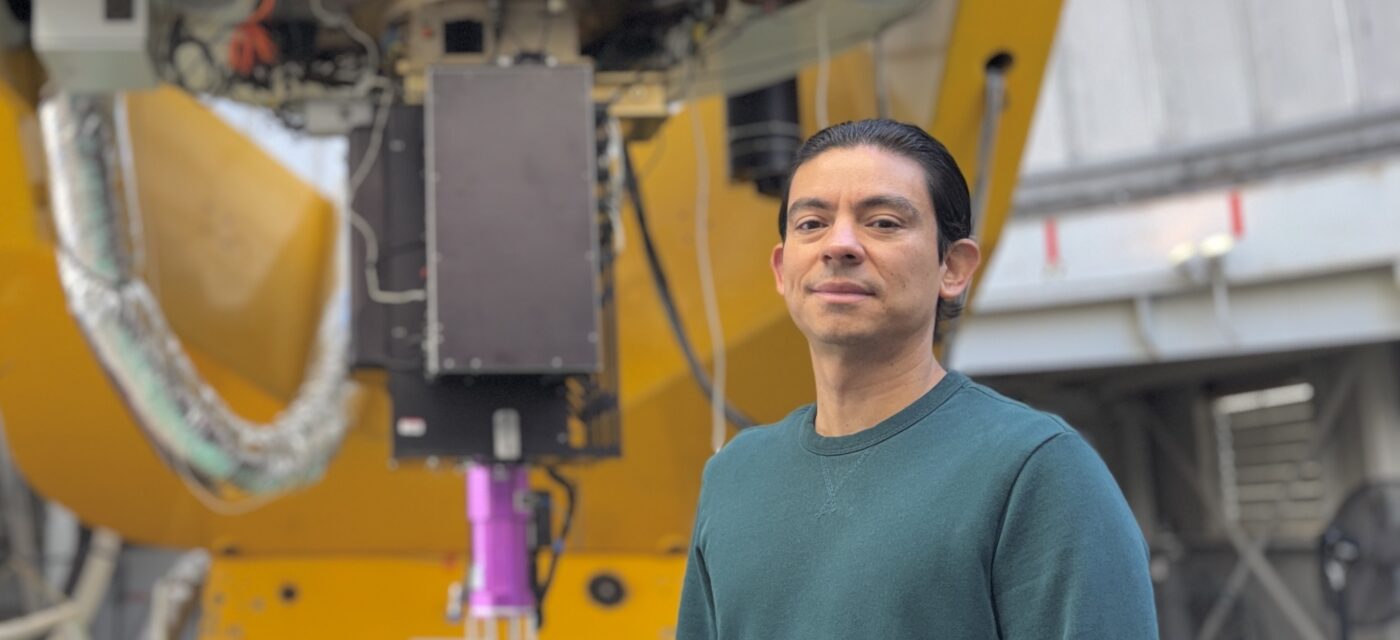
In the next member spotlight, we are featuring Dr Alejandro Núñez of Columbia University, who joined the Mauve Science Programme alongside Professor Marcel Agüeros. Dr Núñez’s work explores how stars like our Sun change their magnetic behaviour as they age. Read about his research and what excites him about Mauve’s unique ability to probe the ultraviolet, a spectral window that has long been out of reach for large-scale stellar studies.
Can you please introduce yourself?
“I am an astronomer at Columbia University, where I study how magnetic activity evolves in low-mass stars as they age and lose angular momentum. My work focuses on stars like the Sun and cooler, lower-mass stars, and on connecting their rotation rates to observable signatures of magnetic activity across different wavelengths.
I combine data from large photometric and spectroscopic surveys with targeted observations. In particular, I have used optical spectroscopy to measure chromospheric activity through H-alpha emission, and X-ray observations from missions such as Chandra, XMM-Newton, ROSAT, Neil Gehrels Swift, and eROSITA to characterize coronal emission. A recurring element of my research is the use of open clusters—stellar populations with well-determined ages—as benchmarks for tracing how stellar activity evolves over hundreds of millions to billions of years.
Within Mauve, I am a member of the “Quiescent Emission in Low-Mass Stars” science team, working with Prof. Marcel Agüeros to extend this multi-wavelength approach into the ultraviolet.”
What inspired you to pursue research in your field?
“I became interested early on in stellar magnetic activity and the way it links a star’s interior, rotation, and atmosphere. What particularly drew me in was the realization that magnetic activity is not confined to a single layer: it manifests differently in the chromosphere, transition region, and corona, and each layer responds in its own way as stars age and spin down.
Open clusters played a major role in shaping my research interests. Because cluster stars share a common age, they provide a powerful framework for isolating evolutionary effects and testing how activity indicators change over time. Working with these populations made it clear that no single diagnostic tells the whole story, and that understanding magnetic activity requires a genuinely multi-wavelength perspective.
That realization naturally led me to the ultraviolet, which probes a key region of stellar atmospheres but has historically been more difficult to study in large, well-characterized samples.”
For me, Mauve represents a natural extension of work I have been doing for many years, adding a critical missing layer to our understanding of how magnetic energy is distributed throughout stellar atmospheres.
Dr Alejandro Núñez
How does your involvement in Mauve align with your research interests?
“My research has long focused on combining chromospheric and coronal diagnostics—such as H-alpha emission and X-ray luminosity, respectively—to study stellar magnetic activity as a function of mass, rotation, and age. The ultraviolet, which originates primarily in the transition region between these layers, has been the least well-constrained part of this picture.
Mauve directly addresses this limitation. Its low-resolution UV spectrophotometry provides a way to characterize quiescent UV emission for stars that already have extensive supporting data, including rotation periods and optical and X-ray measurements. This makes it possible to integrate UV emission into existing activity frameworks rather than treating it as a separate or sparsely sampled diagnostic.
For me, Mauve represents a natural extension of work I have been doing for many years, adding a critical missing layer to our understanding of how magnetic energy is distributed throughout stellar atmospheres.”
Could you describe the science theme you are working on with Mauve?
“Our science theme focuses on quiescent UV emission in low-mass stars and its connection to other indicators of magnetic activity. While flares are important, quiescent emission dominates a star’s long-term high-energy output and provides a more stable view of magnetic heating processes.
We are interested in how UV emission scales with fundamental stellar properties such as rotation, mass, and age, and how it compares to chromospheric and coronal tracers. By targeting stars in open clusters spanning a wide range of ages, we can directly examine how quiescent UV emission evolves as stars spin down over time.
A central goal is to assess whether UV emission follows the same trends seen at optical and X-ray wavelengths, or whether it reveals new behavior that reflects changes in magnetic structure or energy transport across atmospheric layers.”
What aspect of Mauve are you particularly excited for?
“What excites me most about Mauve is that it fills a long-standing observational gap in the UV. Many previous studies have relied on broadband UV photometry (à la GALEX), which enables large samples but offers limited insight into how emission is distributed across the spectrum. At the other end, higher-resolution UV spectroscopy—primarily with HST/COS—provides detailed diagnostics but is restricted to very small samples.
Mauve occupies a valuable middle ground. Its low-resolution spectrophotometry provides more physical information than broadband measurements while still allowing observations of statistically meaningful samples of stars. This balance is particularly important for identifying population-level trends with rotation, mass, and age.
For stars that already have well-characterized optical and X-ray activity measurements, Mauve makes it possible to place quiescent UV emission on the same empirical footing as other magnetic diagnostics.”
What synergies do you see between Mauve and other ground-based/space-based telescopes?
“Mauve naturally complements existing ground- and space-based facilities. Optical spectroscopy provides chromospheric diagnostics such as H-alpha and Ca II, while time-domain photometry from missions like Kepler, K2, TESS, and ZTF yields high-quality rotation periods. X-ray observatories probe the hottest plasma in stellar atmospheres.
Mauve links these regimes by targeting the transition region, allowing chromospheric and coronal diagnostics to be interpreted in a unified framework. These synergies are especially powerful for nearby stars and open-cluster members with rich archival data.
In addition, Mauve observations are highly relevant for future exoplanet-focused missions, where understanding stellar UV environments is essential for interpreting planetary atmospheres and their long-term evolution.”
How has your experience been working with the Mauve Science Collaboration?
“My experience with the Mauve science collaboration has been very positive. The team brings together researchers with complementary expertise, which has led to productive discussions about observing strategies and scientific priorities.
I’ve especially appreciated the collaborative and open nature of the group, and the emphasis on developing coherent science programs that fully leverage Mauve’s capabilities. As someone joining during the first year of science operations, it has been rewarding to contribute to shaping early analyses that will inform work in later mission phases.”